Yesterday, I was in a thrift store, and I saw a book, no dust jacket, but a different looking dual-coloured binding, top one inch faded, a sure sign it stood taller than its surrounding volumes, with a paper label on the spine which is unusual.



I picked it up, opened it and noticed the high-quality paper. A quick flip showed it to be a book of poetry, an area that I don’t focus on very much. Now to the title page, author was Dane Rudhyar, someone who I had never heard of to this point in time. The publisher, also new to me, was Hazel Dreis Editions. What caught my eye was the Santa Fe location and the date of 1938. Another flip through the book and I spied a full-page drawing by the author and it was very interesting, indeed. Certainly worth $3, I thought. And then, for the hell of it, I looked up the book on my mobile phone – one copy - $200! Can’t wait to check this book out when I get home.

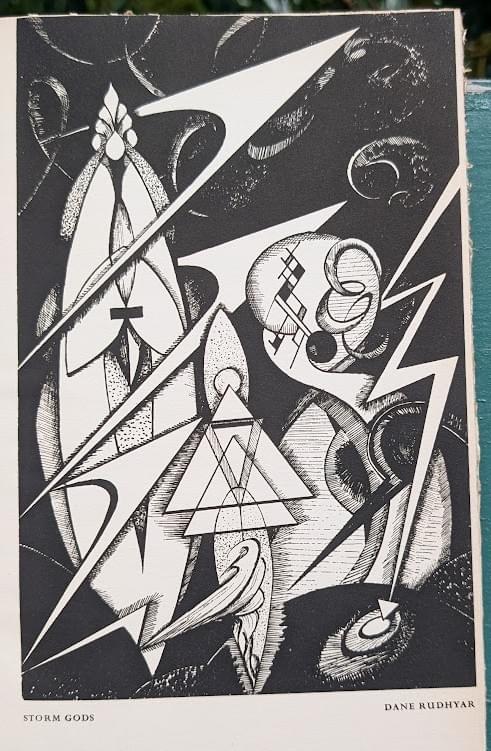
White Thunder; Dane Rudhyar; Hazel Dreis Editions, Santa Fe, New Mexico, 1938.
The first thing I did when I started to research the book was to look up the author, a good sign when the person has a somewhat lengthy Wikipedia page.
Dane Rudhyar (1895 – 1985), born Daniel Chennevière in Paris, was an American author, modernist composer, painter and humanistic astrologer. He was a pioneer of modern transpersonal astrology.
At the age of 12, a severe illness and surgery disabled him, and he turned to music and intellectual development to compensate for his lack of physical agility. He studied at the Sorbonne, University of Paris (graduating at the age of 16), and at the Paris Conservatoire. His early ventures into philosophy and his association with the artistic community in Paris led to his conviction that all existence is cyclical in character. Influenced by Nietzsche as a youth, Rudhyar envisioned himself as a "seed man" of new age cultural evolution.
In November 1916, Rudhyar's music brought him to New York City. He met Sasaki Roshi, one of the early Japanese Zen teachers in America, who led him in the study of Oriental philosophy and occultism. During this period from 1917 to 1919, spent partly in New York City, partly in Canada, and partly in Philadelphia he adopted the name "Rudhyar" a cognate of several attractive Sanskrit words including the name of the god Rudra.
Rudhyar learned astrology during a period when he was also studying the psychological writings of Carl Gustav Jung, and he began to think in terms of bringing astrology and Jungian psychology together. At first, he called his new interpretation "harmonic astrology" and as the ideas matured renamed it "humanistic astrology," the subject of his monumental volume, The Astrology of Personality, published in 1936.
Dane Rudhyar joined the Transcendental Painting Group in Santa Fe, New Mexico in 1938 and 1939. The idea behind transcendental painting and drawing was to paint or draw images of Jungian archetypes. Transcendental painting may be considered a cousin of surrealist art and a precursor of the cosmic art of the 1950s, the psychedelic art of the 1960s, and the visionary art of the 1970s. Throughout his career, Dane Rudhyar continued to paint and draw new transcendental artwork, or use artwork he had previously painted, to illustrate his pamphlets and books about astrology.
Well, this guy was a bit of a Renaissance Man, I said to myself. A musician, author and painter, creating new paths in each of these areas.
Here are photos of the pages surrounding the title page, as well as the listing of his poems, which certainly seemed to reflect his unusual beliefs. This book was his third book of poetry.

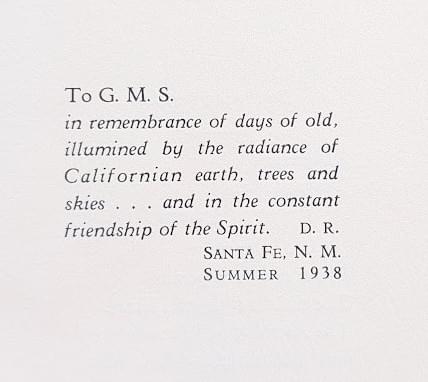
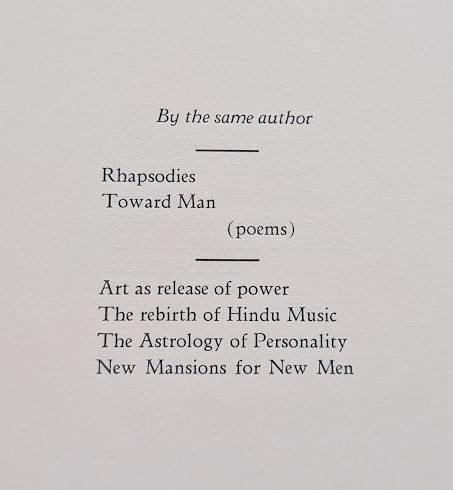
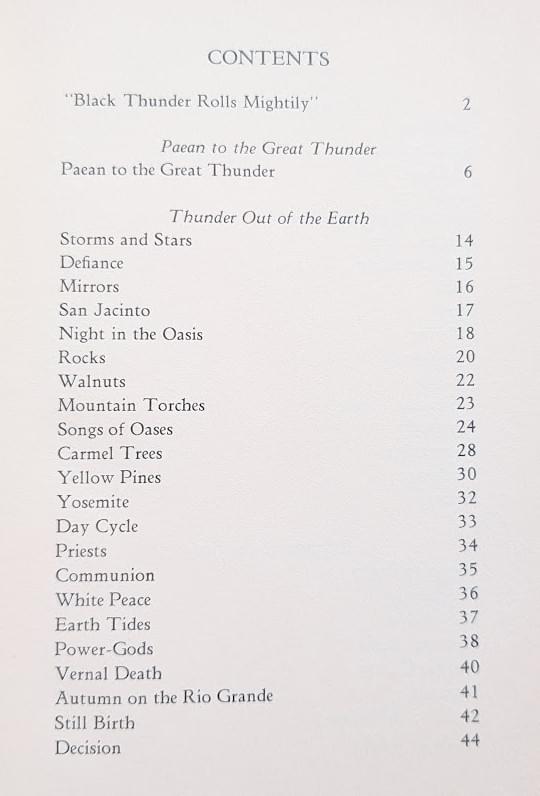
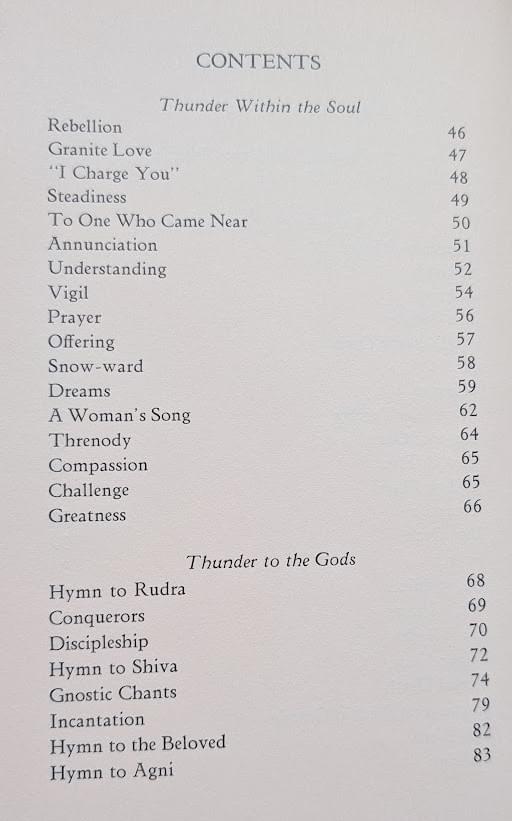
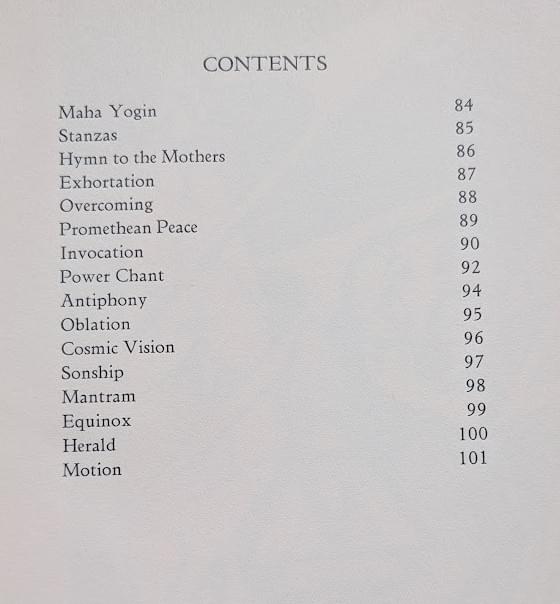
Now, I turned my attention to Hazel Dreis, the publisher. Turns out she was important in her field as well.
Dreis was an internationally recognized American master hand bookbinder, publisher, and printmaker. She played a prominent role in fine-press printing and book arts in San Francisco, Berkeley, and later Santa Fe, working with famed printers like the Grabhorn Press and binding iconic artistic folios. (The Grabhorn Press was one of the foremost producers of finely printed books in twentieth-century America. The Grabhorn Press Building is listed on the National Register of Historic Places in San Francisco, California.)
She hand-bound the ultra-rare 1930 fine-press edition of Taos Pueblo, featuring original photographs by Ansel Adams. She moved her studio to New Mexico in 1939, where she and her protégé, Edward McLean, created unique art bindings and ran private publishing ventures like Hazel Dreis Editions.
Yes, this book does have the feel of a private press book, I thought. I wonder if there is a colophon? Yes, indeed, the surprise of the day.
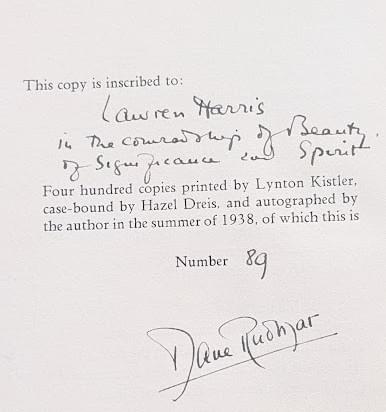
A private press book, indeed, #89 of 440, signed by Dane Rudhyar, but the big surprise was a presentation inscription addressed to Lawren Harris, one of the famous Canadian Group of Seven artists. It reads “in the comradeship of Beauty of Significance and Spirit.”
How did Dane know Lawren. Off to view Lawren’s Wikipedia page – “In these years, he moved to Hanover, New Hampshire in 1934, then Santa Fe, New Mexico in 1938 and finally, Vancouver in 1940. After a period of experimentation, from 1936 on, Harris enthusiastically embraced abstract painting.”
So, Lawren was in Santa Fe in 1938. But this was just an “in passing” comment. Time to look up the Transcendental Painting Group Wikipedia page. And there was the answer!
The Transcendental Painting Group (TPG) was an artist collective, established in 1938 in Santa Fe, New Mexico. The group's goal was to provide an alternative to the prevailing currents of social realism and regionalism that dominated art in the 1930s United States. Under the leadership of Raymond Jonson and Emil Bisttram, the artist group consisted of Agnes Pelton, Lawren Harris, Florence Miller Pierce, Horace Pierce, Robert Gribbroek, William Lumpkins, and Dane Rudhyar. Most of the members lived and worked in New Mexico, with the exception of Agnes Pelton, who was active in Southern California.
The group sought to produce artwork that would go beyond the superficial physical world. Their manifesto formulated their intention "… to carry painting beyond the appearance of the physical world, through new concepts of space, color, light and design, to imaginative realms that are idealistic and spiritual." Stylistically they were strongly inspired by theosophy.
This explains both the nature of the illustration in this book and how the two artists knew each other.
What a wonderful association copy.
And another example of the fun I have as a Book Person.